
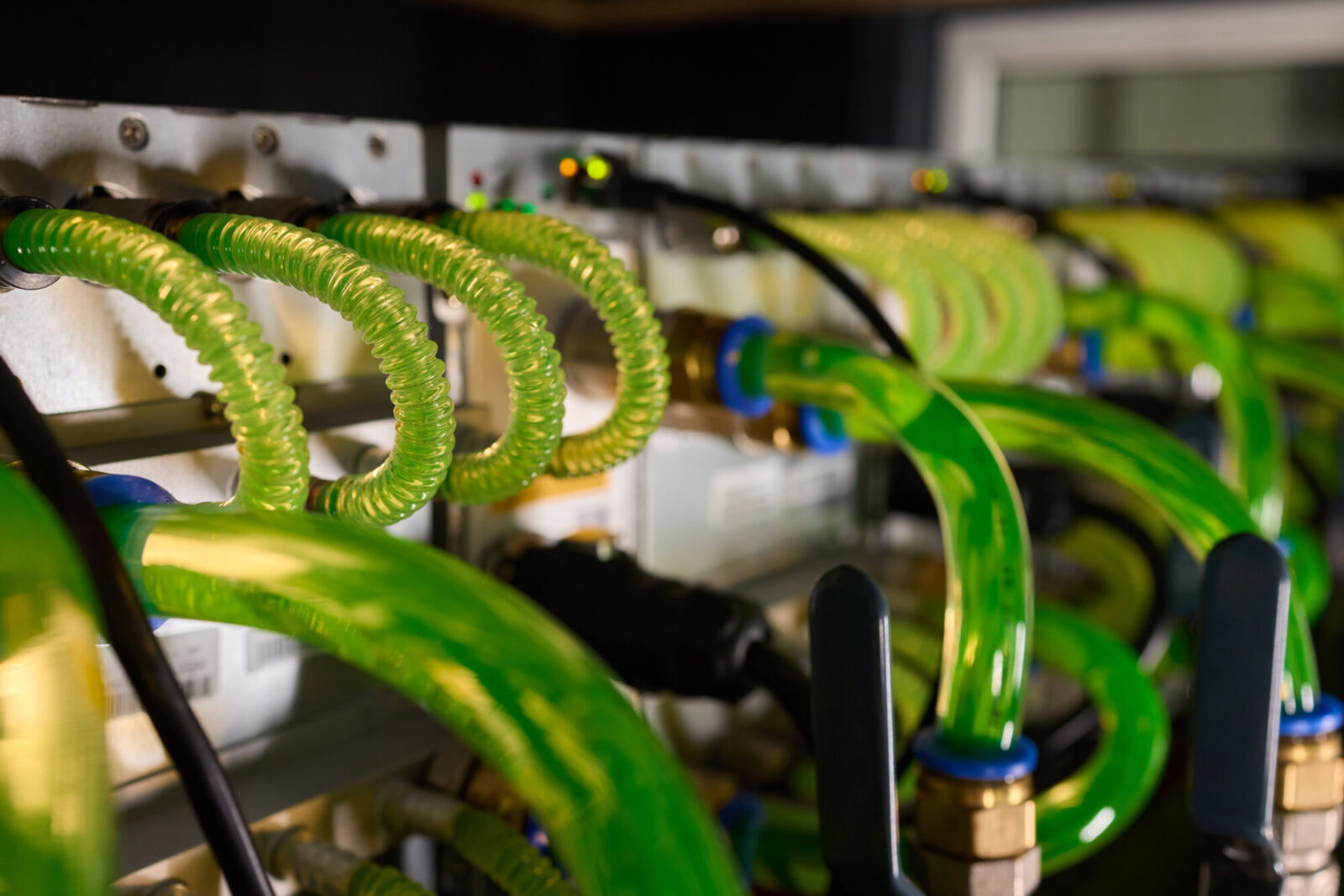
As data centers adopt liquid cooling technologies to support the demands of AI and other high-performance computing applications, the conversation around fire protection strategy and smoke detection is also evolving. Fire detection using air-sampling detection, which worked well when only air was used to cool server equipment, remains critical to the safety strategy as liquid-cooled servers enter the data center.
We’ll explore whether traditional spot-type smoke detectors or aspirating smoke detection (ASD) systems are better suited for these next-generation cooling environments.
Understanding the Challenge
Liquid-cooled data center racks still require lots of air for cooling. In most applications, only heat from the processor is cooled by the liquid system. The rest of the server still generates heat and requires cooling. High airflow conditions will still be present in a data center employing liquid cooling. Thus, air-sampling smoke detectors will remain the preferred method for fire detection in a high-performance data center.
The capital cost of servers and fully populated server racks climbs significantly in a data center meant for AI processes using liquid cooling – we have heard estimates of $8 million US per rack. Thus, fire protection engineers should consider adding smoke detectors to each rack to gain additional intelligence on where smoke may be coming from.
In liquid-cooled racks:
- Smoke may be trapped within sealed enclosures.
- Failure modes can involve smoldering conditions well before any open flame is present, requiring early detection.
- The replacement value of the equipment in the rack is dramatically higher than that of servers of the 2010s.
NFPA 75 Requires Smoke Detection in Data Centers
NFPA 75, Standard for the Fire Protection of Information Technology Equipment, requires smoke detectors to be installed in data centers for early fire detection (9.2.1). Smoke detection should be installed at ceiling level throughout the IT equipment area; below the raised floor where cables are present; in the exhaust/return air stream for aisle containment systems; and in the return air stream if the area above the ceiling is used as a return air plenum.
When applying smoke detection to individual server racks, NFPA 75 provides additional guidance (9.2.3): detectors or sampling ports should be located in the main airflow at exhaust vents; use multiple sampling ports when there are multiple vent locations; and each compartment must have its own sampling port.
Traditional Smoke Detectors vs. Aspirating Smoke Detection (ASD)
| FEATURE | TRADITIONAL SPOT-TYPE DETECTORS | ASPIRATING SMOKE DETECTION (ASD) |
| Sensitivity | Moderate | Very high (detects tiny smoke particles) |
| Performance in Low Airflow | Poor (delayed detection) | Excellent (actively samples from target areas) |
| Deployment Location | Ceiling, room-level, or inside rack (hard to access) | Ceiling, room-level, at air returns, or inside racks or enclosures |
| Detection Speed in Sealed Racks | Slow | Fast (direct sampling inside enclosures) |
| Maintenance | Challenging inside racks and above IT equipment | Easier (centralized detectors with accessible pipes) |
| False Alarm Resistance | Can be prone to false alarms if improperly located | High: filtration stages reduce false alarms |
| Cost (initial investment) | Lower | Higher, but better suited for critical applications |
Why ASD is the Recommended Approach
Given the operating environment of liquid-cooled racks, ASD is generally the preferred solution.
- Proactive Detection: ASD systems continuously draw air from inside or near the rack, ensuring that even minimal smoke is detected early.
- Adaptability: Sampling points can be precisely placed where smoke would first appear — inside coolant compartments, power distribution units, or enclosed rack spaces.
- Reliability in Low Airflow: Unlike spot detectors that rely on natural smoke migration, ASD creates its own airflow, eliminating dependence on environmental conditions.
Best Practice: Layered Detection Strategy
For the most robust protection, experts recommend:
- In-rack ASD systems are configured with sampling pipes inside or adjacent to liquid-cooled racks.
- Supplementary ceiling-level detectors to provide general area protection and redundancy.
- Integration with rack environmental monitoring systems for a holistic safety approach.
Conclusion
Liquid cooling is transforming data center design, but it also requires a rethink of fire and smoke detection strategies. While traditional spot-type detectors still play a role in overall facility protection, ASD systems are the superior choice for smoke detection in liquid-cooled racks and in any space with IT equipment.
By adopting in-rack ASD and integrating it into broader fire protection systems, operators can achieve early warning and enhanced safety in these mission-critical environments.


 Latest Post